
Vessel trace reconstruction
The Trace API reconstructs the historical trajectory of a vessel between two dates based on AIS signals. AIS data provides position reports transmitted by vessels, but these signals can be noisy, incomplete, or inconsistent. To produce meaningful vessel trajectories, Searoutes applies a series of processing steps to transform raw AIS signals into a cleaned and interpretable path.
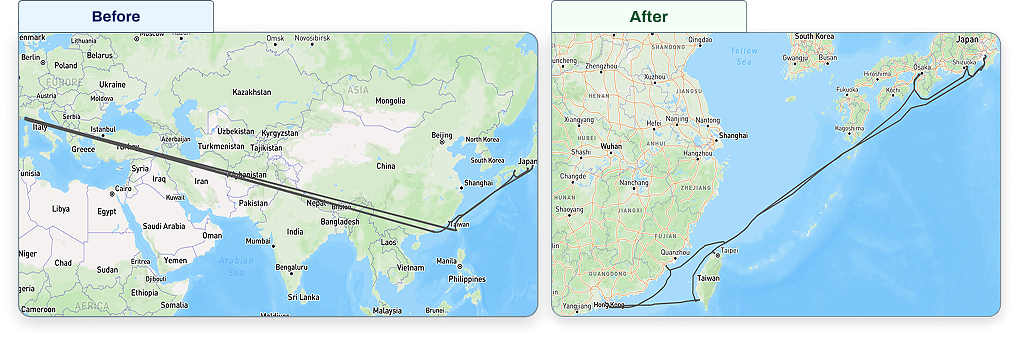
This guide explains how traces are constructed and how AIS positions are cleaned before being returned.
From AIS signals to vessel trajectories
AIS provides a sequence of position reports emitted by vessels over time. These reports typically include timestamp, geographic position (longitude, latitude), speed, course and heading.
When querying the Trace API, Searoutes retrieves all AIS positions associated with the vessel within the requested time range. These raw signals are then processed to reconstruct a realistic trajectory.
However, AIS data cannot be used directly as a trajectory because:
- signals may be duplicated or out of order
- positions can appear far from the vessel’s real location
- large gaps may exist when signals are temporarily unavailable
- identifiers such as MMSI or vessel name can change over time
The trace reconstruction process addresses these issues before producing the final trajectory.
Why cleaned traces differ from raw AIS data
When comparing raw AIS signals with the trajectory returned by the Trace API (/vessel/v2/trace), the results may look different.
The Position (/vessel/v2/position) and Timeseries (/vessel/v2/timeseries) endpoint exposes AIS position reports as they are received from AIS sources.
However, raw AIS data often contain irregularities such as zig-zagging lines near ports, unrealistic detours, clusters of overlapping points, or large jumps caused by by transmission issues or coverage gaps.
The Trace API processes these signals to reconstruct a cleaner and more interpretable trajectory. The resulting trace therefore represents a reconstructed vessel path, rather than a direct replay of every AIS transmission.
The goal is not to reproduce every AIS signal, but to reconstruct the most realistic trajectory supported by the available data.
Trajectory reconstruction and cleaning
🔹 Detecting voyage stops
To improve trajectory reliability, the trace cleaning process also identifies periods where the vessel is stationary, typically corresponding to port operations or anchorage.
These stops act as stable reference points in the trajectory reconstruction.
Instead of cleaning the entire trajectory in a single pass, the cleaning process can operate between detected stops, ensuring that trajectory segments are anchored on reliable positions.
This approach improves the robustness of the trajectory reconstruction and prevents errors caused by unreliable starting points.
🔹 Cleaning inconsistent AIS signals
AIS data contains many irregularities. Before building a trajectory, Searoutes performs a cleaning process designed to remove or correct inconsistent positions while preserving the vessel’s real movement.
The cleaning process focuses on identifying positions that are unlikely to represent the vessel’s true path.
Main cases include:
Outlier positions
Some AIS signals may appear far away from the surrounding trajectory due to transmission errors or signal collisions. These points can create unrealistic jumps in the vessel path. The cleaning process detects and removes such outliers to prevent unrealistic detours in the reconstructed route.
Inconsistent movement patterns
Positions that would require the vessel to travel at impossible speeds between consecutive points are flagged as unreliable. These points are removed to preserve a physically plausible trajectory.
Duplicate or noisy signals
AIS transmissions may generate multiple positions very close to each other or small oscillations while a vessel is stationary. These are filtered to simplify the trajectory and focus on meaningful movement.
🔹 Validating trajectories forward and backward
AIS trajectories can contain errors at both the beginning and the end of the dataset. To improve robustness, the trajectory is evaluated in both directions. This means that the cleaning process analyzes the path:
- forward in time
- backward in time
Comparing both perspectives helps identify inconsistent points that might otherwise appear plausible when analyzed from only one direction.
🔹 Managing vessel identifiers to ensure trajectory continuity
Vessels can change certain identifiers over time, such as their MMSI or name. Since the IMO number represents the vessel itself, the trace reconstruction uses IMO associations to retrieve AIS positions across identifier changes when possible. This ensures a continuous trajectory even when other identifiers evolve during the vessel’s lifetime.
🔹 Handling gaps in AIS coverage
AIS coverage is not continuous across the world’s oceans. Temporary gaps may occur due to:
- limited satellite coverage
- terrestrial reception limits
- transponder outages
- congested AIS environments
When AIS signals are missing for a period of time, a gap appears in the trajectory.
In some cases, the trajectory can still be reconstructed by connecting reliable positions before and after the gap. However, if the gap is too large, the reconstructed trajectory may only represent the known segments of the voyage.
Large gaps can therefore result in simplified trajectories or missing stops in the trace.
Known limitations
Despite cleaning and reconstruction processes, vessel traces remain dependent on AIS data quality.
Certain situations may still affect the result (large AIS coverage gaps, ambiguous vessel identifiers, missing signals during port operations, extreme outliers at the start or end of a trajectory...). In rare cases, when the data is too unreliable, only partial trajectories may be returned.
Summary
The Trace API reconstructs vessel trajectories by combining AIS position signals with a cleaning and validation process designed to produce realistic vessel paths.
The main steps include:
- retrieving AIS positions for the vessel and time range
- filtering inconsistent or unrealistic positions
- identifying voyage stops
- validating trajectory segments forward and backward in time
- reconstructing a clean path representing the vessel’s movement
This approach enables Searoutes to transform noisy AIS signals into usable historical vessel trajectories for analysis, visualization, and operational insight.
Updated 7 months ago